
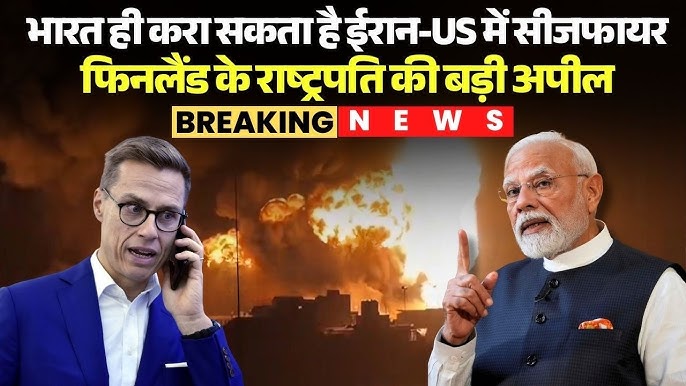
In a Bloomberg interview, Finland’s President Stubb highlighted the conflict’s risks after US and Israeli strikes on Iranian sites began on February 28, 2026, now in its third week with civilian casualties and Strait of Hormuz disruptions. He suggested India could mediate, citing External Affairs Minister S. Jaishankar’s calls for de-escalation and successful talks ensuring safe passage for Indian ships. India’s ties with all sides—defense with Israel and the US, energy with Iran—position it uniquely, though the government has not yet responded to the proposal.
Finland’s President Alexander Stubb has made a strong international appeal for a ceasefire in the ongoing conflict involving the United States, Israel, and Iran, and has proposed India as a potential key mediator to help de‑escalate rising tensions in the Middle East.
In a recent statement, President Stubb highlighted the urgent need to end hostilities that have continued for more than two weeks, urging world leaders to focus on diplomatic solutions and peaceful negotiations rather than prolonged military engagement. His remarks come amid growing global concern over the conflict’s impact on regional stability and energy markets.
🌍 Why India?
President Stubb specifically pointed to India’s balanced foreign policy and trusted diplomatic relations with major global powers — including both Western capitals and Tehran — as reasons why New Delhi could serve as an effective intermediary in negotiations. He noted that India’s neutral yet engaged approach could open channels of dialogue between the conflicting parties.
India has maintained a policy of strategic caution and neutrality throughout the conflict, emphasizing dialogue and de‑escalation in international forums. External Affairs Minister S. Jaishankar has repeatedly called for a ceasefire to reduce tensions and protect civilian lives, a stance that aligns with Stubb’s suggestions.
🔎 What Stubb Asked For
In his comments, Stubb stated, “We need a ceasefire. I’m wondering if India can actually get involved… We saw Foreign Minister Jaishankar call for a ceasefire to calm things down.” His statement reflects a growing international sentiment seeking peaceful resolution over continued escalation.
By inviting India to step into a diplomatic role, Stubb hopes to leverage New Delhi’s global influence — particularly its strong ties with both Western allies and nations in the Middle East. This reflects a shifting dynamic in international diplomacy where global South powers are increasingly recognized as viable mediators in conflicts traditionally dominated by Western actors.
🕊️ What This Could Mean
If India chooses to engage in mediation:
- It could help secure a ceasefire agreement acceptable to all parties.
- A successful mediation effort could boost India’s global diplomatic standing.
- It might pave the way for broader peace negotiations involving other regional powers.
📌 Global Reaction
Analysts believe that involving respected non‑aligned nations could provide fresh momentum toward peace negotiations, as many traditional mediators have struggled to bring conflicting parties to the table. India’s neutral stance and strategic autonomy are seen as potential assets in bridging divides.
https://www.ndtvprofit.com/india/finland-president-urges-india-to-mediate-us-iran-peace-11226781
About the Author



Nice 👍